
Identify a Fairfield County Property Owner in Four Checks
Finding a Fairfield County owner of record takes two records and two verification checks. Because Connecticut keeps land records and assessment data local, the path depends on the town where the parcel sits.
- Confirm the municipality and standardize the situs address.
- Search its official assessor system and copy the owner, co-owner, parcel ID, and roll date exactly.
- Search that municipality's clerk index for the newest deed into the named owner.
- Match legal description, book/page or instrument, transfer date, and parcel reference.
Use two sources. An assessor card is a dated assessment record; the latest recorded deed is the title evidence to check against it.
When the assessor and the deed disagree, that gap is information. Report both dates and ask whether a recent transfer is still moving through the assessor's update cycle. The newer record usually explains the older display.
What “Who Owns” Means in Fairfield County Records
Ownership in Fairfield County records can mean several things. The tax roll carries a name. The latest deed names a grantee. A beneficial interest may sit behind an entity, and occupancy is a separate question entirely. Public property records support only some of these claims. Quote the source label exactly, and resist stretching it into a broader conclusion about the person behind it.
- Owner of record
- The owner name on a dated assessment card.
- Grantee
- The person or entity receiving an interest in a deed.
- Legal description
- The parcel language connecting an instrument to land.
- Situs address
- The physical property address, separate from mailing address.
The Norwalk sample card shows why the distinction matters. It separates owner, co-owner, address, MBLU, PID, assessment, sale, and book/page fields, so each label stays tied to its own record.
Fairfield County Has No Countywide Owner Search
Fairfield County spans 23 municipalities, and each one has its own assessor and clerk. Bridgeport and Stamford run municipal Vision portals for assessment discovery. Norwalk moved its current assessor workflow to DataScout on January 16, 2026. Old bookmarks may still open a legacy card. Begin at the official Norwalk Tax Assessor page. For any other town, locate its official assessor and land-record pages directly. The statewide OPM parcel layer can orient a property search. But local submissions vary, and OPM does not edit municipal data.
Read the Fairfield County Owner Field Exactly
Copy the owner and co-owner fields exactly as displayed. Save the situs, mailing address, parcel ID, roll date, and book/page reference too. A mailing address can belong to an owner, trustee, manager, or payment office, and it never establishes occupancy on its own.
| Card field | Use | Limit |
|---|---|---|
| Owner and co-owner | Name lead for clerk search | Tied to roll date |
| MBL, MBLU, PID, or account | Connects local systems | Format varies by town |
| Book/page | Points toward an instrument | May not be newest deed |
| Mailing address | Explains tax correspondence | Does not prove residence |
The current Norwalk DataScout route shows the municipal search screen in action. There you can locate a parcel and read its dated owner fields.
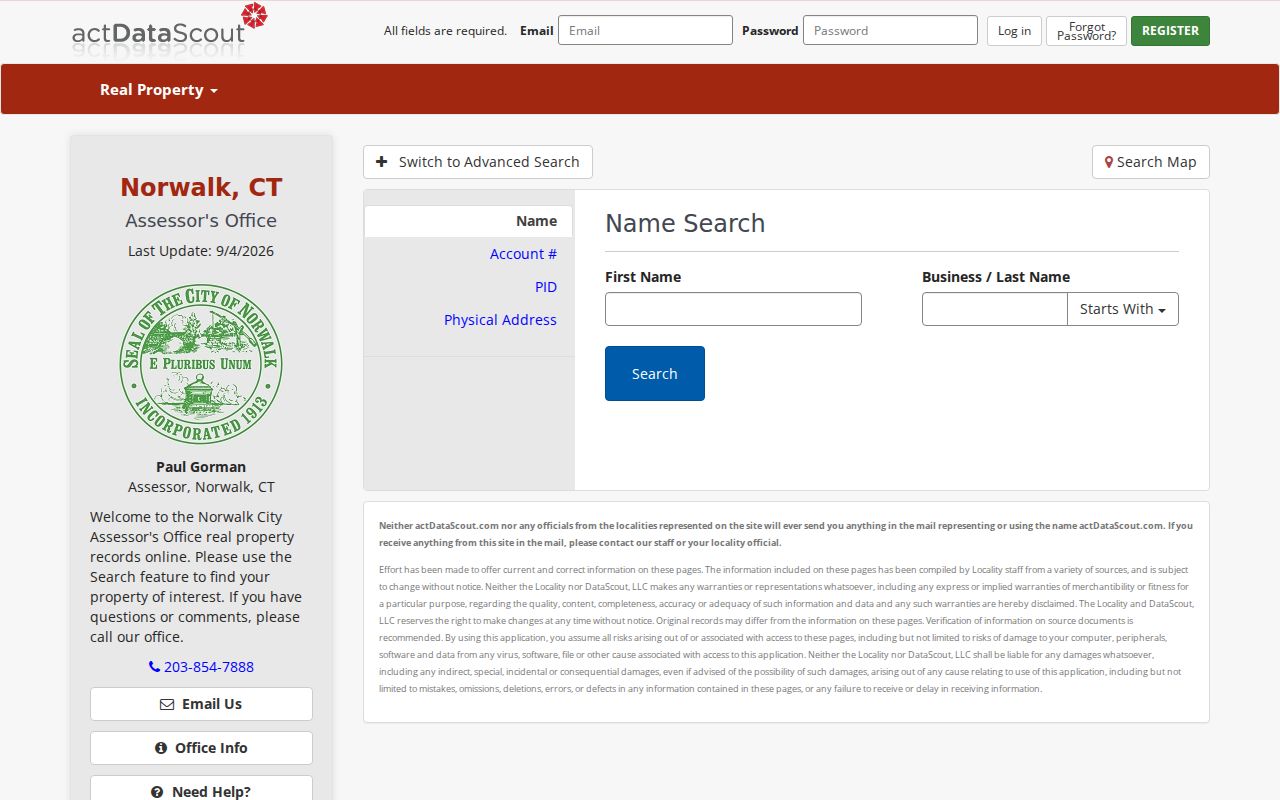
A search route is not a substitute for reading. The returned parcel card and the newest deed still do the real work, so preserve the result date and the municipal identifier. The current property owner guide focuses on that dated card and its freshness.
Trace the Fairfield County Owner Lead to a Deed
Connecticut places land records with the municipal clerk. Start by searching the assessor name as grantee, allowing spelling and entity-name variants. Use a date range reaching back before the card's sale date. Inspect the newest plausible deed. Then match municipality, parties, recording date, and deed type. Check the legal description, map or lot references, and the prior-deed citation too. A shared name alone is weak proof. Bridgeport offers current and legacy search systems with different features. Follow the official Town Clerk route for its deed records.
When a Fairfield County Property Owner Is an Entity
When the card names an LLC, trust, estate, or nominee, keep that label as the reported owner. Never swap in an assumed person. The official Connecticut business searches can confirm an LLC's filing name, jurisdiction, and history, though they do not decide land title. Trust and estate records may explain a transfer path. Probate material can help. Even so, the deed and its legal description remain the true property cross-check.
Resolve a New Deed and an Older Fairfield County Roll
Assessment records follow dates, anchored to an October 1 grand-list date. No countywide rule fixes how many days an owner update takes. So a new deed can show up before the assessor display changes.
| Mismatch | Check | Next source |
|---|---|---|
| New deed, prior owner on card | Recording and roll dates | Assessor update status |
| Same owner, different spelling | Name variants | Grantor/grantee index |
| Address matches, parcel differs | Unit, lot, or split | GIS and legal description |
Record the disagreement rather than choosing one convenient name.
Stamford Property Alert Adds a Fraud Check
Stamford Town Clerk offers a free Property Alert that flags recordings matching a registered name. The city warns that same-name matches happen. An alert neither stops a recording nor proves fraud. Check the official Property Alert page for current terms. Owners elsewhere should ask their clerk about local options rather than assume county coverage.
Offline Ways to Find a Fairfield County Property Owner
When a portal fails, go in person. Use the assessor counter or a public terminal. Call ahead for the parcel number, and inspect the clerk's vault or index. Norwalk documents public terminals, a street index, and tax maps. Stamford provides public-vault land-record access. Older evidence may live in deed books, microfilm, the State Library, or the State Archives. A Connecticut Freedom of Information request goes to the agency holding the record. Name the address, municipality, parcel ID, record type, and date range. Ask for inspection or an electronic copy, not a title opinion or a list of hidden beneficial owners.
Use Fairfield County Owner Records Lawfully
Public access does not make every inference sound. A mailing address is not a residence. A GIS polygon is not a survey. A voter lookup is not an owner database, and protected address programs follow separate rules.
Use records for lawful property diligence. Never use owner details to stalk, harass, threaten, or target a person.
For a purchase, estate, boundary, or fraud concern, keep the dates. Seek certified copies or a professional title review when the stakes justify it.