
Read Fairfield County Deed Records by Instrument Type
A recorded deed names the parties, the execution and recording details, the legal description, and the interest it claims to convey. Municipal indexes in Connecticut reach much further than deeds, holding mortgages, releases, assignments, easements, liens, attachments, judgments, restrictions, maps, and condominium declarations. The label on each instrument matters. Not every recorded document transfers ownership.
| Deed Type | What It Does | Common Use |
|---|---|---|
| Warranty deed | States covenants associated with the conveyed estate | Ordinary conveyance research |
| Quitclaim deed | Conveys the interest the grantor has without promising its scope | Interest changes and title cleanup |
| Fiduciary deed | Shows a trustee, executor, committee, or other authorized transfer | Trust, estate, or court-linked research |
| Foreclosure-related deed | Records a transfer tied to a legal process | Must be read with the court and land records |
| Map or subdivision filing | Supplies recorded lot and plan references | Legal-description and parcel-history work |
A mortgage secures an obligation. A release or assignment merely adjusts the recorded mortgage trail. Liens and judgments can burden an interest without ever making their holders owners of record. Search the related names and the parcel description together. Then read the actual instruments before you draw any conclusion from an index line.
Bridgeport Deed Records Split Index and Image Dates
Bridgeport's legacy portal documents its recorded-land index from January 2, 1948. Online images start much later, on June 1, 1983. The map index and its images reach back to September 23, 1835. That split explains a common frustration. A valid citation can appear in the index with no downloadable deed page behind it.
The legacy interface offers Name, Document, Book, and Date searches. Searching is free with watermarked viewing. The posted fee notice prices downloads and prints at $2 per page. Search-result printing runs $1.50 per page. Registration, pop-ups, and Adobe software are also required. Confirm current terms before ordering anything.
The Bridgeport legacy deed index preserves these coverage statements.
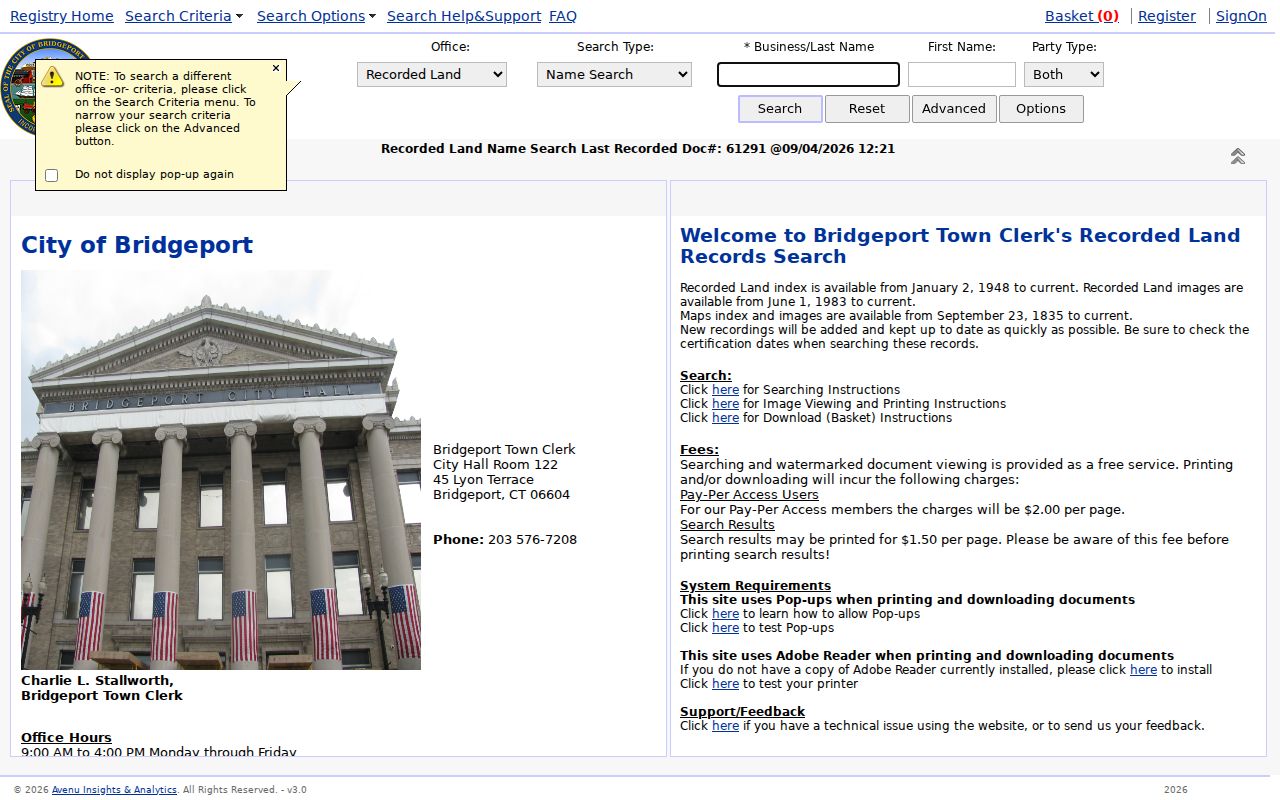
The official legacy interface displays all four documented search modes. It also shows why a book or date search can rescue a difficult name query.
Current Bridgeport Deed Search Adds OCR and Subdivisions
Bridgeport's current publicsearch.us portal offers Quick and Advanced searching. Its prompt accepts grantor, grantee, subdivision, document type, and document number. It also offers recorded-date presets and a choice between Index only and Index and Full Text/OCR. OCR can surface words buried inside an image. Poor scans and handwriting still make the official index and a document review essential.
Start with a precise party name or document number. If that stalls, vary entity punctuation and initials, narrow the date, or search the subdivision. Compare each candidate's legal description, map or lot, and prior-deed reference. Check the parties against the target property. An address alone is not the strongest key for a deed index.
Findings that earn a section: the recorder portal's grantor-grantee search fields and coverage years (render the search-field table); the imaging cutover and the microfilm/deed-book era; image and certified-copy fees; the property-fraud alert service;
Follow Fairfield County Grantor and Grantee Names
Connecticut's land-record framework keeps municipal books with the Town Clerk and requires grantor and grantee indexing. The grantor conveys the interest. The grantee receives it. A chain of title is simply the ordered series of matched transfers, and book/page or instrument numbers serve as clerk citations for pulling an exact filing.
- Use the assessor owner label as a lead and search that party as grantee.
- Match a candidate deed by municipality, legal description, parcel clue, and recording date.
- Read the matching deed and save its grantor, grantee, book/page or instrument number, and prior reference.
- Search the grantor's earlier acquisition as a grantee, repeating until the desired date or online cutoff.
- Grantor
- The party that transfers the stated interest.
- Grantee
- The party that receives the stated interest.
- Chain of title
- The linked sequence of instruments affecting ownership over time.
- Book/page or instrument number
- The municipality's retrieval citation for a recorded filing.
Stamford Deeds Combine Online Access and a Public Vault
Stamford's Town Clerk reports land records online back to 1998. The vault stays open to the public Monday through Friday, 8:00 a.m. to 3:30 p.m. Recent work can be done online. Older deed-book or map research is better in person.
The posted fees list copies at $1 per page and certification at $2 per document. Recording costs $70 for the first page. Each later page adds $5. Maps record at $20. Subdivision maps with three or more parcels record at $30. Recording charges are not research-copy costs. Confirm every fee before making a request.
Norwalk Deed Records Lead to Permanent Record Classes
Norwalk's Town Clerk keeps a long list of permanent record categories. Attachments, conveyances, deeds, judgments, liens, maps, mortgages, tax liens, and miscellaneous land documents all fall under it. The public may inspect records during normal hours. A live municipal land-record search is available, though the city publishes no earliest online year for it.
So do not assume a Norwalk cutoff date. Use the online index for discovery. Then turn to the clerk, the Norwalk History Room, the Malcolm P. Hunt Collection, or state repositories when the chain reaches older material. A recorded map often beats a street address. That is especially true when a subdivision lot or a renamed road is in play.
Fairfield County Deed Names Need Variant Searching
Personal names need surname-first order, middle initials, spelling variants, and forms borrowed from earlier documents. Entity names should be searched with and without punctuation or abbreviations. Trustee, estate, marital, and fiduciary formats shift from one instrument to the next. Treat any same-name result as a mere candidate until the property description matches.
An LLC search through the Connecticut Secretary of the State can clarify formation or filing context. But it cannot replace the deed. It may not reveal beneficial ownership. A probate case can explain an estate transfer. A mortgage assignment or release can explain an encumbrance trail. Yet neither one transfers the land.
Request a Fairfield County Deed From the Right Clerk
Start with the municipality and the exact citation. Then download the image if the official portal permits it on acceptable terms. Older deeds work differently. Certified copies, missing images, and recorded maps sit with the city or town clerk holding that volume. Give the clerk the grantor, grantee, document type, and approximate recording date. Add the book and page too. If no citation is known, narrow the date and the record class rather than asking the office to build a title search, which it does not have to create. Connecticut FOI guarantees access to existing public records. For an identified deed, though, a clerk's established copy channel is usually the direct path. Say whether you want inspection, a copy, or certification.
Recorded, not guaranteed. Fairfield County deed records show instruments accepted by a municipal clerk. They do not supply a title opinion or rule out unrecorded interests.
Property Alerts Monitor Names, Not Parcels or Title
Stamford offers a free Property Alert service. It notifies a subscriber when a deed or mortgage is recorded under the subscribed name. The city warns that the system is name-based. A filing by someone else with the same name can still trigger a notice. Bridgeport's current portal also offers registration and a Property Alert route. Alerts spot activity quickly. They cannot block a recording, review authenticity, or prove ownership. Confirm any notice in the municipal index first. Contact the clerk whenever a filing looks unfamiliar, and keep subscribed name forms broad enough to catch initials and entity variations without treating every hit as a problem. The Stamford alert signup remains the official name-monitoring route.
Maps and Easements Complete a Fairfield County Deed Search
Ownership is only one slice of a land-record review. Easements, rights-of-way, restrictions, and condominium declarations can change how land is used. So can boundary-line agreements, mortgages, releases, and liens. Search the names and references in the deed rather than stopping at one conveyance image. Subdivision maps and surveys matter most when an old deed lacks a current street address. Bridgeport documents map coverage reaching into the nineteenth century. Stamford and Norwalk publish special map or subdivision-map fees. Match the map title, lot, sheet, and recording citation to the deed. The municipal web map is not the recorded plan.