
Check the Fairfield County Current Owner Card
A Fairfield County current owner search starts with the assessor in the parcel's own municipality. Each town answers separately. No county assessor exists. Bridgeport and Stamford each run municipal Vision Online systems. Norwalk moved its live assessor route to DataScout in January 2026. Field labels vary from system to system. Copy every identifier exactly. Treat the card as a dated record.
| Owner or co-owner | The name or names carried on the dated assessment record |
|---|---|
| Mailing address | The destination for assessment and tax correspondence, which may differ from the parcel |
| Situs address | The physical property being checked |
| MBL, MBLU, PID, or account | The municipality's local parcel key |
| Book and page | A lead to a recorded instrument in the municipal clerk's index |
| Assessment date | The roll date that gives the owner field its time context |
Norwalk's sample card splits owner, co-owner, location, MBLU, PID, assessment, sale, and book/page data into separate fields. That separation matters. The owner of record does not prove who occupies the parcel, a tax mailing address does not establish residence, and a representative's address proves nothing at all. Verify the vesting through the deed.
Read Fairfield County Owner Fields on Their Date
Connecticut assessment rolls are date-specific. The municipal grand-list framework ties to October 1 each year. A sale recorded after the applicable roll date may not show in the assessor's owner field yet. No countywide rule sets the refresh pace. The 23 towns each set their own schedule for updating an online card.
Date the result. Record the card's assessment date and the day accessed; a current owner field can lag a newly recorded deed.
Report both sources and their dates whenever names conflict, instead of trusting the cleaner-looking screen. A clerk's recording after the roll date often explains a mismatch. So can a stale vendor page left behind after a migration.
Norwalk's 2026 Portal Change Affects Current Owner Checks
Norwalk states that it changed from VGSI to DataScout effective January 16, 2026. The switch is an interface change only. The roll and the titles did not change. Begin at the Norwalk Tax Assessor page so the city, not an old bookmark, selects the current system for Fairfield County current owner work. The DataScout source shows the present route.
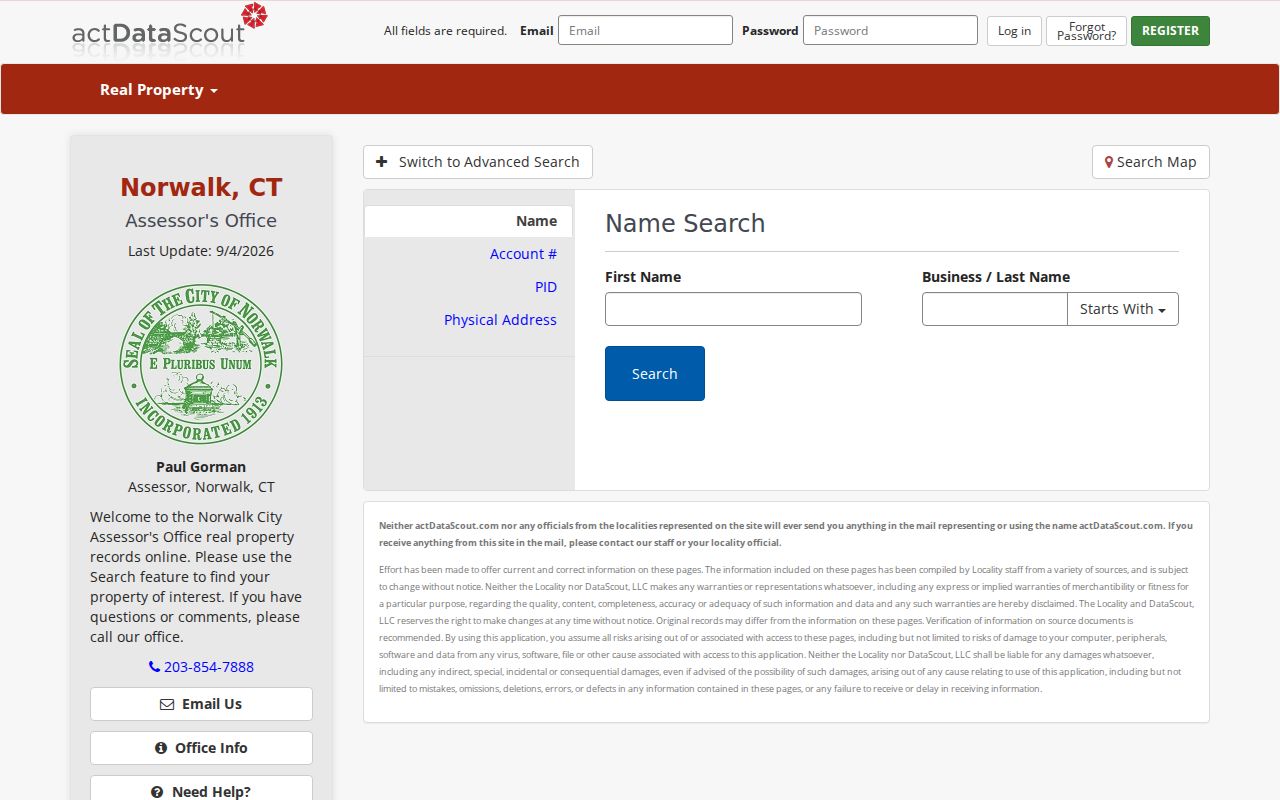
Keep any older VGSI result only as dated evidence. Its book/page or historical field may still help, but the city's current assessor page controls the live route for a Fairfield County parcel lookup.
Separate a Fairfield County Owner From the Mail Recipient
An assessment card in Fairfield County can list a situs address, an owner name, a co-owner name, and a separate mailing address. Each line answers a different question. The situs identifies the land, and the owner field names the taxpayer carried on that roll. The mail line shows where notices go. None of it proves occupancy.
The distinction matters most for estates, trusts, businesses, and owners whose correspondence goes to a representative. Copy the labels as shown. Never turn a mail recipient into a title conclusion, and do not infer a personal relationship from a shared address.
Confirm Who Owns a Fairfield County Parcel Now
The latest deed from the municipal clerk is the second source a Fairfield County current owner check needs. Connecticut files land records town by town. There is no county recorder to query. Hold the local parcel identity fixed as the search moves from the assessment card to the deed, and let the clerk's newest matching instrument confirm the owner of record.
- Identify the municipality from the situs address, then open that municipality's assessor source.
- Copy the exact owner, co-owner, parcel ID, assessment date, and available book/page.
- Search the same municipality's clerk index for the newest deed matching the parties and land.
- Compare execution and recording dates, deed type, book/page, legal description, and prior-deed reference.
- If the grantee is an entity, check its exact recorded name in Connecticut's business system without treating an agent as owner.
- Owner of record
- The party named on the dated public record being read.
- Vesting
- The deed wording that states how title is placed in the grantee or grantees.
- Tenancy
- The form in which multiple grantees hold title when the instrument states it.
- Registered agent
- A business filing contact, not proof that the agent owns the real estate.
Verify Entity Names Without Inventing Beneficial Ownership
A deed or assessor card naming an LLC or corporation deserves a follow-up. Run the exact punctuation and spelling through the Connecticut Secretary of the State business searches. Filing history and an entity number can separate similar names or track a renamed company.
A filing does not name every beneficial interest. A registered agent is not automatically the parcel owner. Trust and estate interests may stay off the card. Keep the conclusion narrow. The deed names the grantee, the business record describes the entity, and neither supports claims about the people behind it.
Use Book and Page to Test the Current Owner Match
A surname alone proves little. In Fairfield County's 23 separate record systems, a stronger match pairs book and page with the parcel identifier, municipality, property description, and parties. When an assessor card supplies a deed reference, use it as a bridge. It never substitutes for the clerk's record itself.
Bridgeport provides a current public land search and a legacy system with different coverage. Stamford's online land records run from 1998. Earlier deeds sit in the vault. Norwalk's clerk permanently indexes deeds and other instruments, so the newest matching deed must be sought with the correct municipal clerk.
Resolve a Fairfield County Current Owner Mismatch
A mismatch almost always has a testable cause. Maybe the wrong municipality was searched. Maybe the deed was recorded after the assessment date. The tax roll then still shows the prior owner of record. Name variants, split or merged parcels, and stale portals can all explain the gap too. Instruments filed outside the deed category can too. Start by comparing the parcel number and legal description. Then line up the assessor's date against the deed's recording date. One of those two checks usually settles it.
What if the online index or image is missing? Contact the municipal clerk to inspect the record or request a copy. The request belongs with the agency that holds the record. That rule comes from the Connecticut Freedom of Information Act, General Statutes Chapter 14. Inspection can be requested verbally. An agency may ask for a copy request in writing, though. For older land records, the clerk vault and microfilm remain the practical fallback. State Library preservation guidance supports that route.
Contact a Fairfield County Current Owner Lawfully
The tax-roll mailing line offers a lawful correspondence route. It helps when you need to reach an owner of record. It works for a parcel question, a purchase inquiry, a boundary issue, or a deed correction. Use the address as published. Do not treat it as a home address. Connecticut's Safe at Home program gives eligible participants a substitute mailing address. Yet the program itself warns that land records may stay public unless a specific protection applies.
Lawful use. Use owner data only for legitimate property research or contact; never stalk, harass, intimidate, or target a person.
For a final reliance decision, keep the municipality, access date, card date, current deed, and legal description together. The full owner-finding route is laid out in the Fairfield County ownership guide. This page has a narrower job: confirming who the dated records show as owner now.