
How Fairfield County Property Tax Records Divide the Facts
Fairfield County property tax records live at the municipal level. Every lookup starts with the right town or city rather than a county counter. Each municipality pairs an assessor with a tax collector. The assessor sets the parcel value and tracks exemptions, while the tax collector issues bills and posts payments. Timing matters, since a transfer, revaluation, or payment can reach one office before the other. To search Fairfield County property tax records by address, note the parcel identifier as you go. Also note the assessment year. Confirm any figure that matters with the office that keeps it.
| Tax record item | Question it answers | Municipal source |
|---|---|---|
| Market or appraised value | Estimated full value on the dated roll | Assessor |
| Assessed value | Tax-base value, generally 70% of market value | Assessor |
| Exemption | Applied relief or adjustment | Assessor |
| Bill and payment status | Charges, installments, payments, and balance | Tax collector |
| Lien or tax-sale instrument | Recorded enforcement document | Municipal clerk |
A deed's sale price is not an assessment. It reflects one transaction, not the market estimate or assessed figure the assessor maintains today. Check the date on every source before comparing numbers. The Fairfield County property value guide unpacks those labels in detail.
Fairfield County Property Tax Starts With the Municipality
Fairfield County runs no countywide assessor, collector, or unified tax roll. All 23 municipalities keep their own systems. So the first step is pinning the address to Bridgeport, Stamford, Norwalk, or another town. Be careful near town lines. A postal place name can mislead and a tax district may not match the mailing city.
The statewide OPM Parcel and CAMA program can help you find local data layers. OPM cautions that submissions vary and that it does not edit them. Treat it as a discovery tool, then verify against the live municipal card and bill.
Why Fairfield County Assessments Use a 70% Base
Connecticut puts most taxable real property on the grand list at 70% of fair market value. So a card may show both a market figure and a lower assessed figure without any conflict between them. The mill rate then applies to the taxable assessed amount, after exemptions and any lawful phase-in.
- Market value
- The assessor's dated estimate of full value.
- Assessed value
- The statutory share used as the starting tax base.
- Mill rate
- Tax charged per thousand dollars of taxable assessment.
- Tax lien
- A claim arising from unpaid municipal tax, distinct from the bill.
Never multiply a stale card by a current mill rate and expect the collector's number. Relief programs, district rates, corrections, and posting dates all move the final bill. Read the card and the account together, with dates.
Three Fairfield County Revaluation Clocks
Dates drive everything here. Bridgeport finished a 2025 revaluation and issued final figures in January 2026. Stamford lists October 1, 2022 as its current revaluation date. It points to 2027 for the next cycle. Norwalk reports a 2023 revaluation with a phase-in running from 2024 through 2028.
| Municipality | Research checkpoint | Detail to save |
|---|---|---|
| Bridgeport | 2025 revaluation | Roll year and correction or appeal status |
| Stamford | 2022 value date; 2027 next cycle | Market date and taxing district |
| Norwalk | 2023 revaluation; 2024-2028 phase-in | Phase-in year and displayed value |
None of that forms a county schedule. For any other municipality, check its assessor page and the current Board of Assessment Appeals notice.
Norwalk's Fairfield County Tax Search Fields
Norwalk's Tax Collector shows how a bill system stands apart from the assessor. Its official page links the tax search and posts notices on payment history, delinquency, liens, tax sale, and redemption. Search fields include list year, bill type, last name, address, unique ID, and a due-now option.
| Search field | Best use |
|---|---|
| List year and bill type | Keep real-estate charges in the right billing period |
| Last name or address | Find candidate accounts when an ID is unknown |
| Unique ID | Return to a known account despite spelling changes |
| Due now | Focus on an open balance while retaining dated history |
Go to the official Norwalk Tax Collector page for live tax access and current operational notices.
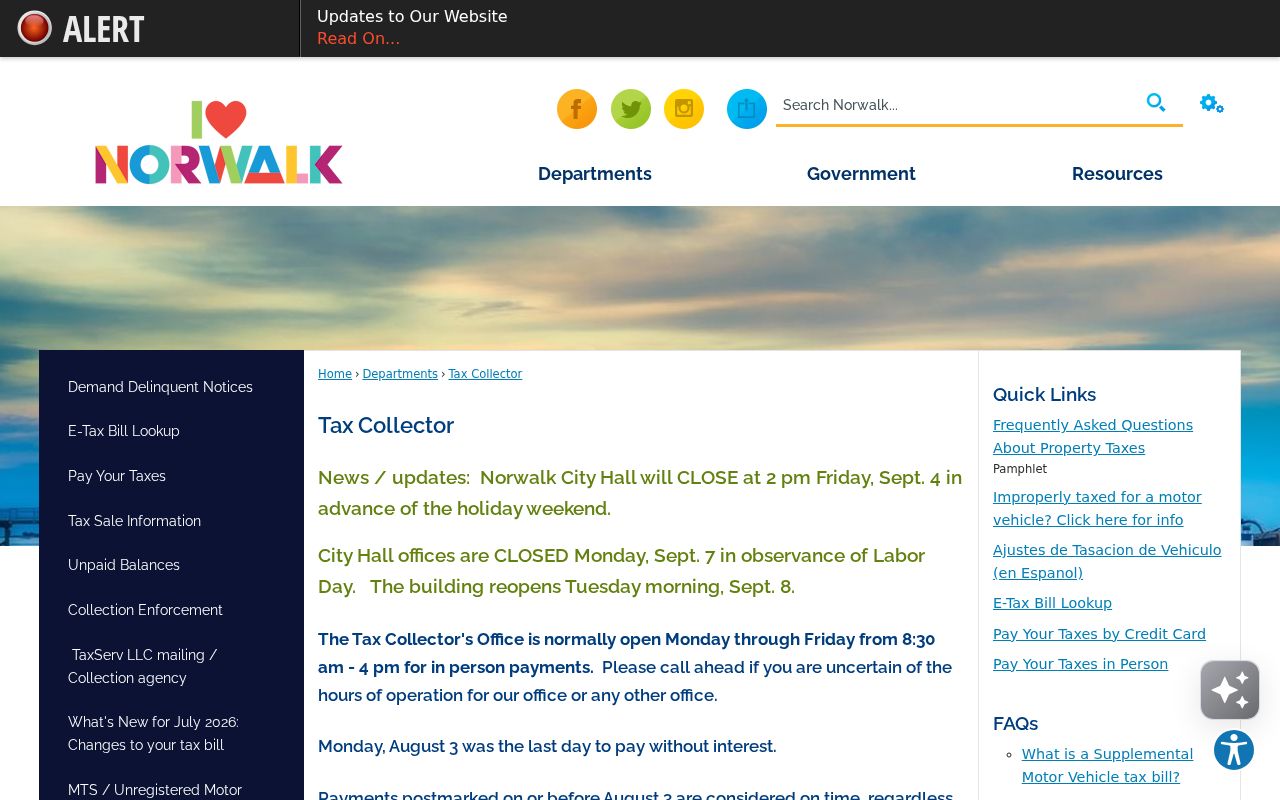
Norwalk's collector provides a five-year payment-history route for anyone tracing past tax bills. A balance shown online is only a dated view. A recent payment may not appear yet, so note the time you checked and confirm any payoff directly with the collector before relying on the figure.
Look Up a Fairfield County Tax Bill in Order
A careful Fairfield County property tax search respects the handoff from assessment to billing. Start on the municipality's own assessor or collector page, never a county-branded directory.
- Confirm the municipality and copy the parcel, account, or map-block-lot ID from its assessor card.
- Open the official collector search and choose the correct list year and real-estate bill type.
- Compare the charge, installments, payment postings, balance, and available prior-year history.
- Return to the assessor card for exemptions, valuation fields, and assessment date.
- If delinquent, ask the collector for current payoff information and check the clerk index for a recorded lien.
Save the date of every search. A payment, correction, or ownership change can land in one system before another.
When Fairfield County Property Tax Portals Fall Short
Online portals are only one channel. Norwalk documents public assessor terminals. It also lists a street index, tax maps, self-service copies, staff or fax copies, purchasable indices, and custom files. Other municipalities may offer a counter, phone help, mail, email, or a formal records request. Call ahead during a vendor migration or revaluation. The Connecticut Freedom of Information Act permits a verbal inspection request. An agency can require writing for copies, though. Ordinary municipal copies may run up to 50 cents per page. Specialized files and clerk documents follow their own published schedules. Name the property, year, record type, parcel ID, and preferred electronic format when asking.
Exemptions Are Separate Fairfield County Records
An exemption on a card records an adjustment to that roll, nothing more. It does not prove the owner still qualifies. Assessors publish each program's filing route. State law sets the larger framework. So confirm the deadline, proof, renewal rule, and affected grand list locally. When a bill looks too high, compare years and parcel IDs first. Then ask whether a revaluation, phase-in, lost exemption, transfer, or taxing-district change explains it. The collector runs the account; the assessor owns valuation and exemption records.
Contest a Fairfield County Assessment, Not the Mill Rate
An assessment appeal targets valuation or classification only. It cannot touch the mill rate. That rate belongs to the municipality itself. Each city or town publishes its own application. It also sets its own Board of Assessment Appeals schedule. The filing window depends on the grand-list year and local notice.
Protect the appeal window. Confirm the current deadline directly with the assessor or Board of Assessment Appeals before preparing evidence.
Bring the dated field card, a property description, proof of any factual errors, and market evidence. A dispute over a payment posting, balance, lien, or redemption figure belongs with the collector instead. That is a billing question, not a valuation one.
Verify Fairfield County Property Tax Findings
Close the loop with a complete evidence set. Include the municipality, parcel ID, situs address, and the owner or taxpayer label. Add the assessment date, market and assessed values, list year, and bill number. Round it out with the payment-through date. Note any exemptions. Note any lien instrument attached to the parcel. When something does not match, do not guess at which figure is right. Compare the dates on each record instead.
For any consequential use, ask the responsible office for a certified copy. A current statement works too. A saved portal page is fine as working evidence. But it can miss a payment still processing, a recent correction, or the latest recorded document.